3D simulation · Atoms and nuclear
Atoms, fission and fusion, in 3D
Atoms splitting and fusing, radioactivity, and how the Sun shines. Not a drawing and not an AI guess: a simulation that runs the real numbers, narrated, with every moment landing on its word.
What the simulation shows
- An atom: a tiny nucleus with a cloud of electrons around it (labelled).
- Zooms into the nucleus: protons (positive) and neutrons (no charge) packed together.
- The electrons appear as clouds in shells around the nucleus.
- Pulls far back: the atom is almost entirely empty space (callout).
- 100 radioactive nuclei: each decays at a random moment, flicking out a particle.
- The count halves every half-life: 100, 50, 25… (the chart).
- A neutron hits a uranium nucleus and it splits in two with a flash.
- The split's neutrons hit more nuclei, which split and release more: a chain reaction spreading through.
- Two light hydrogen nuclei collide and fuse into helium, throwing out a neutron and a flash of energy.
- A callout: E = mc², a little mass turned into a lot of energy.
The real numbers it runs on
The simulation is built on these facts, so the narration and the picture always agree:
- An atom is a tiny nucleus of protons and neutrons surrounded by electrons. The number of protons decides the element: carbon has 6.
- The nucleus holds 99.9% of the mass but is 100,000 times smaller than the atom: if the nucleus were a marble, the atom would be a stadium, and the rest is empty space.
- Electrons aren't little planets; they're spread out as clouds of probability, in shells.
- Unstable nuclei decay at random moments, but in a large number exactly half decay in each half-life: carbon-14's is 5,730 years, which is how carbon dating works.
- Fission: a neutron hits a uranium-235 nucleus, which splits in two and releases 2 to 3 neutrons and energy; those neutrons can split more: a chain reaction (controlled in a power station).
- Fusion: light nuclei merge into heavier ones. The Sun fuses about 600 million tonnes of hydrogen into helium every second; about 0.7% of the mass becomes energy (E = mc²).
The script this video was made from
“How the Sun shines”: the narration of the video above. Each highlighted moment in the simulation happens on the word that names it.
The Sun burns no fuel, at least not like a fire. It does something far more powerful.
The smallest atom
This is hydrogen: one proton, one electron, and almost entirely empty space.
The crash
In the Sun's core, hydrogen nuclei slam together so hard they fuse into helium.
The missing mass
The helium weighs a tiny bit less. That missing mass becomes energy, E equals m c squared, and it's sunlight.
Make your own
- Type a question, like “How the Sun shines”, or your own angle on it.
- ContentRoof picks this simulation, researches the facts and writes a short script, with every moment cued to a word.
- A natural voice reads it in your language and the simulation plays in time with it. Change any line and it follows.
- Download a vertical video for Shorts, TikTok and Reels, or use it in class.
Questions
Is this a real simulation or an AI-generated video?
A real simulation. Atoms, fission and fusion runs on the numbers listed above, so what you see is what actually happens, frame by frame. AI video generators guess what a scene should look like; they often get the science wrong.
Can I change what the narrator says?
Yes. Type your own question or idea and the AI writes a new script for this simulation, or edit any line yourself. Every moment of the simulation lands on the word that names it.
Which languages can it narrate in?
Eleven: English, Urdu, Hindi, Arabic, Spanish, French, Portuguese, German, Italian, Russian and Polish, with captions written properly (Urdu in Nastaliq, Arabic right to left).
Can I use it in class or post it on YouTube?
Yes. The video is yours to use in lessons, on YouTube Shorts, TikTok and Instagram Reels. The free plan makes 2 3D simulations a month; paid plans make more, in 1080p without the small mark.
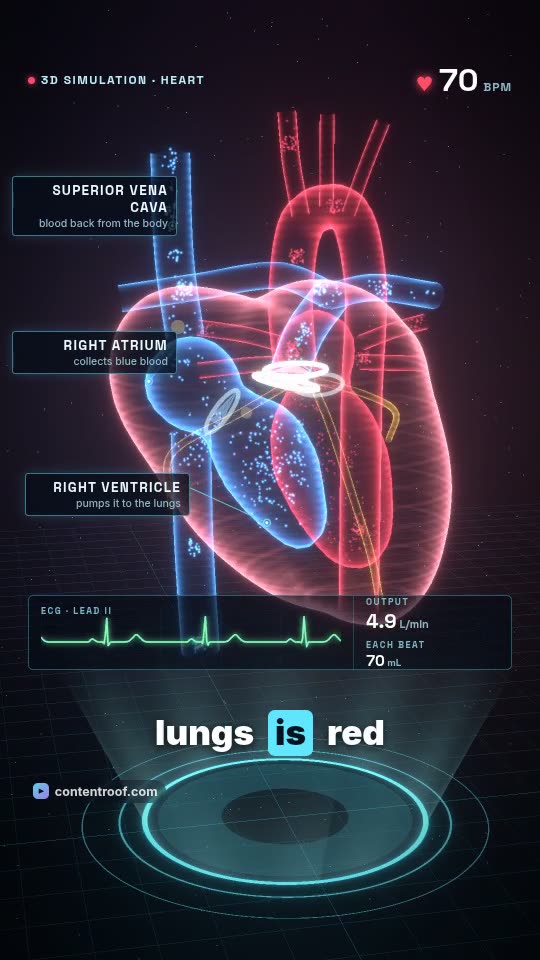 How the heart pumps blood
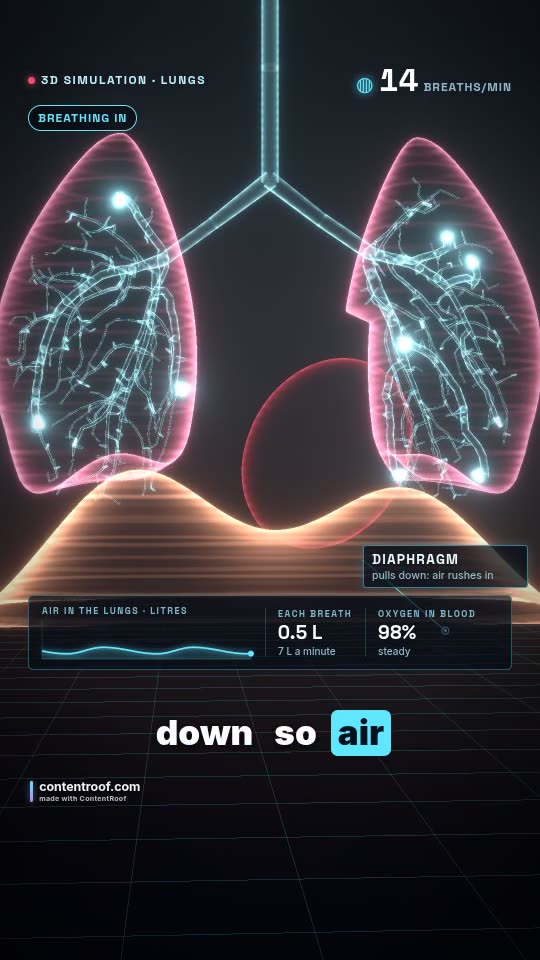 How the lungs work
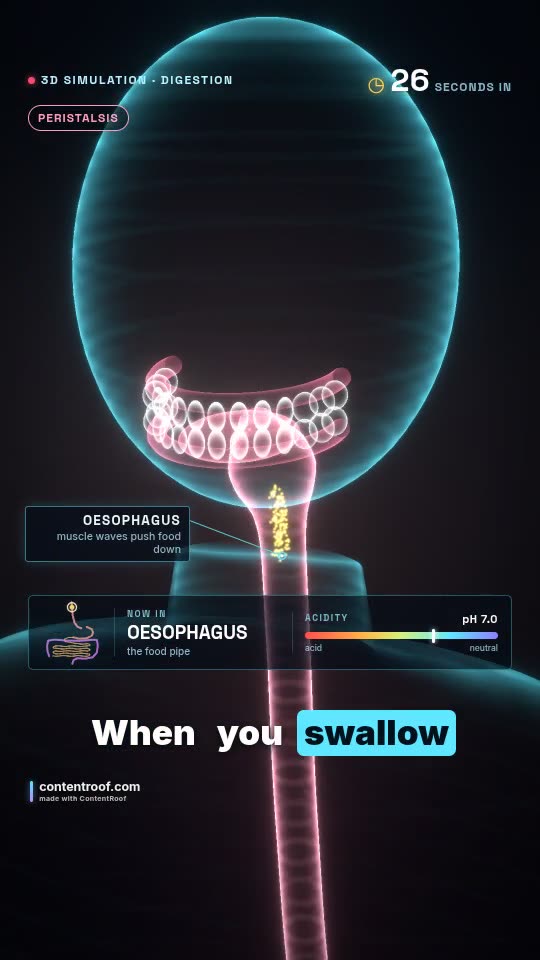 The digestive system
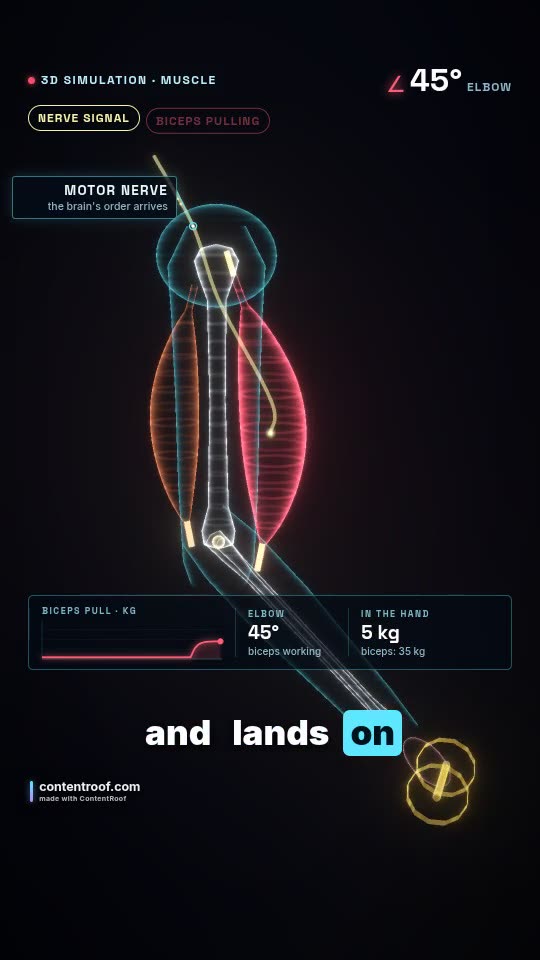 How a muscle moves a bone
 How the eye works
 How a vaccine trains your immune system
 DNA
 How a neuron sends a signal