3D simulation · Body organs
How a muscle moves a bone, in 3D
A muscle pulling on a bone like a lever, the fibres sliding inside it, and the signal from the nerve that makes it contract. Not a drawing and not an AI guess: a simulation that runs the real numbers, narrated, with every moment landing on its word.
What the simulation shows
- Signals race down the motor nerve into the biceps; its nerve ending flashes and the muscle twitches (labelled).
- Zooms 20,000× into one muscle fibre: three sarcomeres in a row; calcium floods out of its stores and the myosin heads start grabbing the actin (labels calcium and myosin).
- Up close: the myosin heads pull, let go and pull again; the thin actin filaments slide towards the middle and every sarcomere shortens from 2.5 to 2 micrometres (labels actin and the Z-discs).
- The whole arm: the biceps shortens and bulges, its tendon pulls the forearm up round the elbow and the weight rises (labelled).
- The forearm held level as a lever: the biceps pulls 5 cm from the elbow, the weight is 35 cm away, so the biceps pulls 7 times the weight (arrows, distances, callout).
- The biceps relaxes and the triceps, on the back of the arm, pulls the arm straight again: muscles only pull (labelled).
- Curl after curl: each one a little slower and lower as the muscle's fuel runs down (a rep counter and a fuel gauge).
The real numbers it runs on
The simulation is built on these facts, so the narration and the picture always agree:
- The body has more than 600 skeletal muscles. Muscles can only pull, never push, so they work in pairs: the biceps bends the elbow, the triceps straightens it.
- A muscle moves only when a nerve tells it to: the signal travels down a motor nerve (up to about 120 metres a second) and at the nerve ending a chemical messenger sets off an electrical wave across the muscle fibres.
- That wave makes each fibre release calcium from its internal stores. Calcium uncovers grip sites on the thin actin filaments.
- Myosin heads on the thick filaments grab the actin, pull it towards the middle, let go and grab again, burning one molecule of ATP (the cell's fuel) each time. The filaments slide past each other; neither gets shorter (the sliding filament theory).
- A muscle fibre is a chain of tiny units called sarcomeres, each about 2.5 micrometres (thousandths of a millimetre) long at rest; when they all shorten together, the whole muscle shortens.
- A shortening muscle gets fatter (it keeps its volume): that's the biceps' bulge. Its tendon, a tough cord, pulls on the bone.
- The biceps pulls about 5 centimetres from the elbow while the hand is about 35 centimetres away, so it must pull about 7 times the weight in the hand; in return the hand moves 7 times as far and as fast.
- In hard exercise the fibres' fuel runs low and they make less force: the muscle tires and each movement gets slower.
The script this video was made from
“How your biceps lifts”: the narration of the video above. Each highlighted moment in the simulation happens on the word that names it.
To lift a five kilo weight, your biceps has to pull with thirty five kilos. Here's why it's worth it.
The order
It starts in your brain. A signal races down a nerve and lands on the muscle.
The grab
Inside each fibre, calcium floods out, and tiny myosin heads grab the filaments beside them.
The pull
They pull, let go and pull again, so the filaments slide together and the fibre gets shorter.
The lever
The whole muscle shortens, and its tendon hauls your forearm up. It pulls just five centimetres from the elbow, so it needs seven times the force, but your hand moves seven times as far.
The pair
To lower it, your triceps pulls the other way. Muscles can only ever pull.
Make your own
- Type a question, like “How your biceps lifts”, or your own angle on it.
- ContentRoof picks this simulation, researches the facts and writes a short script, with every moment cued to a word.
- A natural voice reads it in your language and the simulation plays in time with it. Change any line and it follows.
- Download a vertical video for Shorts, TikTok and Reels, or use it in class.
Questions
Is this a real simulation or an AI-generated video?
A real simulation. How a muscle moves a bone runs on the numbers listed above, so what you see is what actually happens, frame by frame. AI video generators guess what a scene should look like; they often get the science wrong.
Can I change what the narrator says?
Yes. Type your own question or idea and the AI writes a new script for this simulation, or edit any line yourself. Every moment of the simulation lands on the word that names it.
Which languages can it narrate in?
Eleven: English, Urdu, Hindi, Arabic, Spanish, French, Portuguese, German, Italian, Russian and Polish, with captions written properly (Urdu in Nastaliq, Arabic right to left).
Can I use it in class or post it on YouTube?
Yes. The video is yours to use in lessons, on YouTube Shorts, TikTok and Instagram Reels. The free plan makes 2 3D simulations a month; paid plans make more, in 1080p without the small mark.
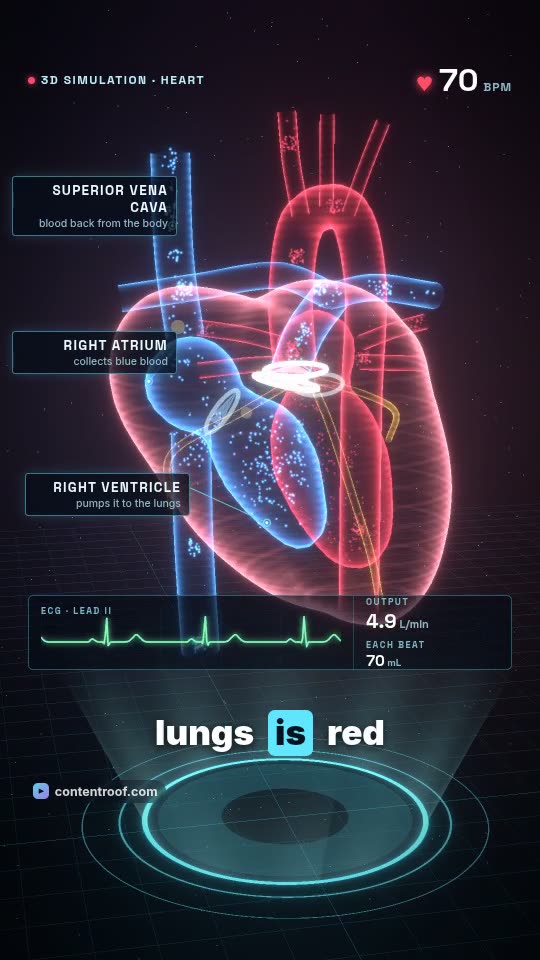 How the heart pumps blood
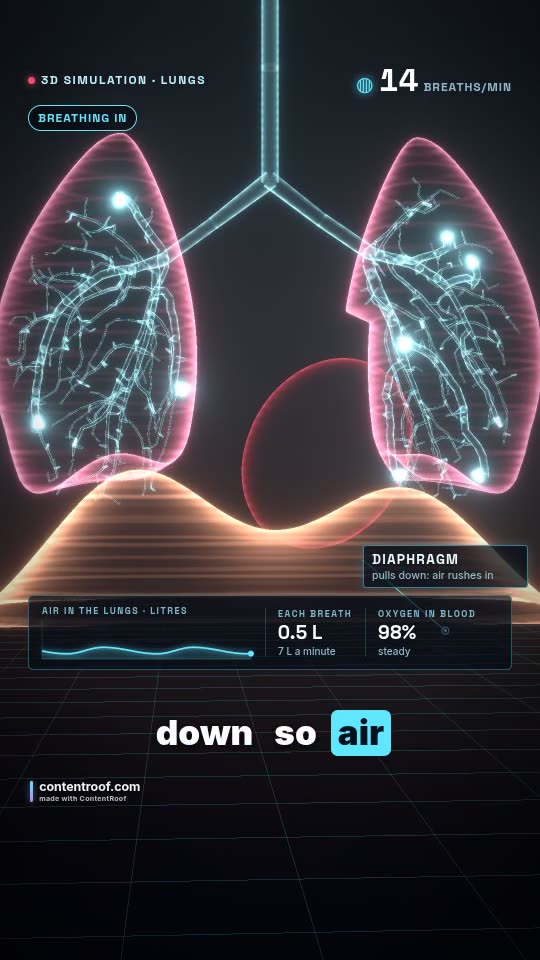 How the lungs work
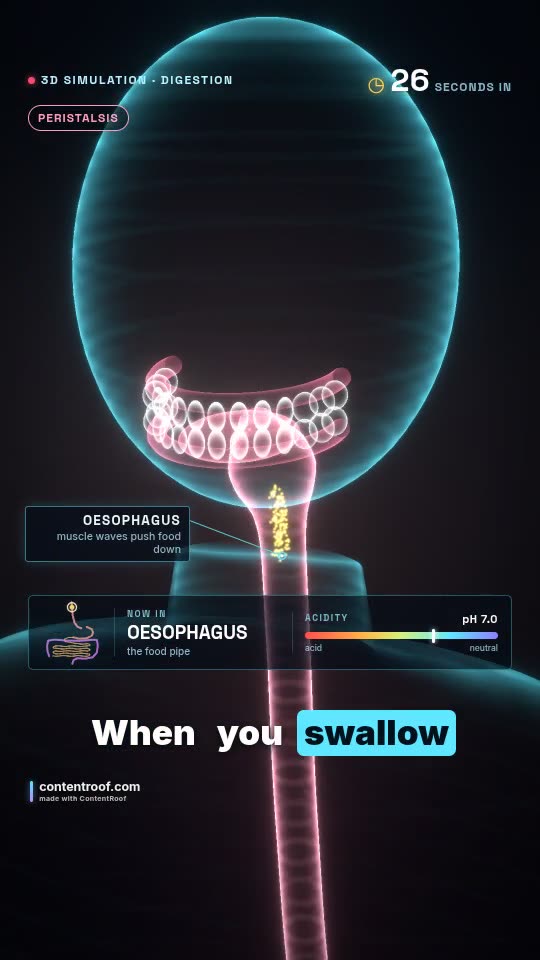 The digestive system
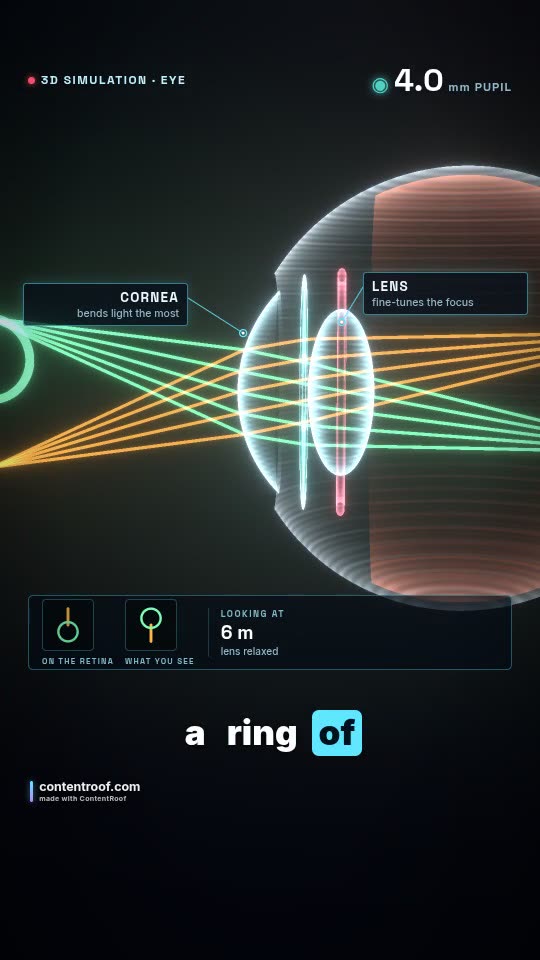 How the eye works
 How a vaccine trains your immune system
 DNA
 How a neuron sends a signal
 Gravity and orbits