3D simulation · Machines and engines
How a car engine works, in 3D
Pistons, spark plugs, the four strokes and the crankshaft, turning fuel into motion. Not a drawing and not an AI guess: a simulation that runs the real numbers, narrated, with every moment landing on its word.
What the simulation shows
- A cut-away engine cylinder, labelled: piston, crankshaft, spark plug.
- Stroke 1: the piston slides down, the intake valve opens and fuel and air are drawn in (diesel: air only; two-stroke: fresh gas rushes in through the transfer port near the bottom).
- Stroke 2: both valves shut, the piston rises and squeezes the mixture.
- Stroke 3: the spark plug fires, the mixture burns and shoves the piston down (the only stroke that pushes). Diesel: fuel is sprayed into the hot air and lights by itself.
- Stroke 4: the exhaust valve opens and the piston pushes the spent gas out (two-stroke: the piston uncovers an exhaust port in the wall).
- Close-up of the spark plug: a spark jumps its tiny gap (a diesel has an injector instead).
- The engine runs, cycling through its strokes.
- The engine revs up to 3,000 rpm, 25 bangs a second.
- Two gears: a small 12-tooth gear turns a big 36-tooth gear, three times slower but with three times the turning force.
- A lever on a pivot: a small push far from the pivot lifts a heavy box close to it.
The real numbers it runs on
The simulation is built on these facts, so the narration and the picture always agree:
- A petrol engine has four strokes: intake (fuel and air drawn in), compression (squeezed to about a tenth of the space), power (a spark ignites it and the hot gas shoves the piston down) and exhaust (the spent gas pushed out).
- Only one stroke in four pushes; the crankshaft and its heavy flywheel carry the engine through the other three.
- The crankshaft turns the piston's up-and-down into spinning; each cylinder fires once every two turns.
- At 3,000 rpm a cylinder fires 25 times a second; a car engine usually has four cylinders taking turns.
- Gears trade speed for turning force (torque): a small gear driving one three times bigger turns it three times slower with three times the force. That's why low gears climb hills.
- A lever trades distance for force: push six times farther from the pivot than the load and you need a sixth of the force. 'Give me a place to stand and I will move the Earth.' (Archimedes)
- A spark plug makes a spark of about 20,000 volts across a gap of about 1 millimetre, at exactly the right moment, thousands of times a minute.
- A diesel engine has no spark plug: it squeezes air to about a twentieth of its space, which heats it above 500 °C, then sprays in fuel, which lights by itself. That makes diesels efficient and strong (lorries, ships, tractors).
- A two-stroke engine (mopeds, chainsaws, small motorbikes) has no valves: the piston itself uncovers ports in the cylinder wall. It fires every turn instead of every second turn, so it's light and powerful for its size, but it burns oil with its fuel and pollutes more.
The script this video was made from
“Inside a car engine”: the narration of the video above. Each highlighted moment in the simulation happens on the word that names it.
Your car's engine is really a series of tiny explosions, 25 every second.
The cylinder
Inside each cylinder, a piston slides up and down.
Four strokes
First it sucks in fuel and air. Then it squeezes it into a tenth of the space. A spark, and the blast shoves the piston down. Finally it pushes out what's left.
Full speed
Now speed it up to three thousand turns a minute, and you're driving.
Make your own
- Type a question, like “Inside a car engine”, or your own angle on it.
- ContentRoof picks this simulation, researches the facts and writes a short script, with every moment cued to a word.
- A natural voice reads it in your language and the simulation plays in time with it. Change any line and it follows.
- Download a vertical video for Shorts, TikTok and Reels, or use it in class.
Questions
Is this a real simulation or an AI-generated video?
A real simulation. How a car engine works runs on the numbers listed above, so what you see is what actually happens, frame by frame. AI video generators guess what a scene should look like; they often get the science wrong.
Can I change what the narrator says?
Yes. Type your own question or idea and the AI writes a new script for this simulation, or edit any line yourself. Every moment of the simulation lands on the word that names it.
Which languages can it narrate in?
Eleven: English, Urdu, Hindi, Arabic, Spanish, French, Portuguese, German, Italian, Russian and Polish, with captions written properly (Urdu in Nastaliq, Arabic right to left).
Can I use it in class or post it on YouTube?
Yes. The video is yours to use in lessons, on YouTube Shorts, TikTok and Instagram Reels. The free plan makes 2 3D simulations a month; paid plans make more, in 1080p without the small mark.
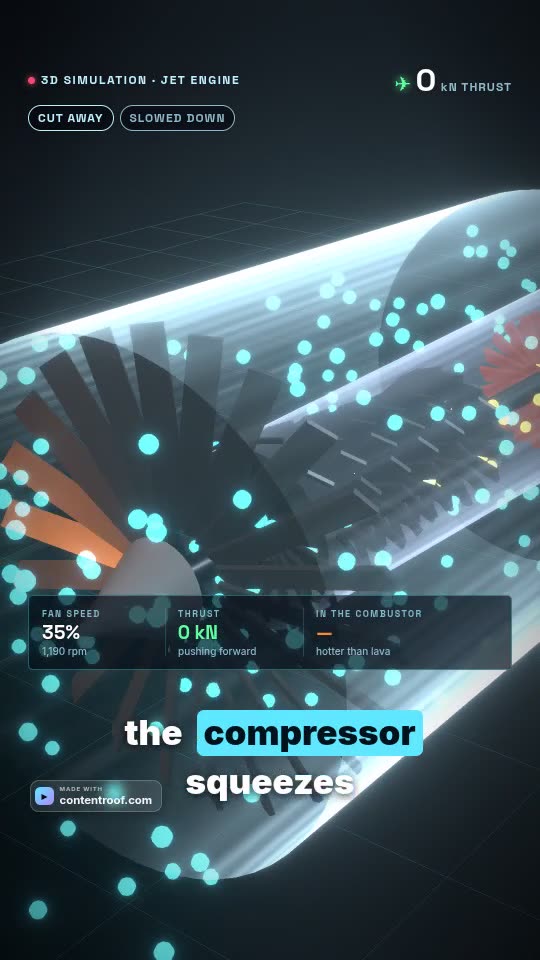 How a jet engine works
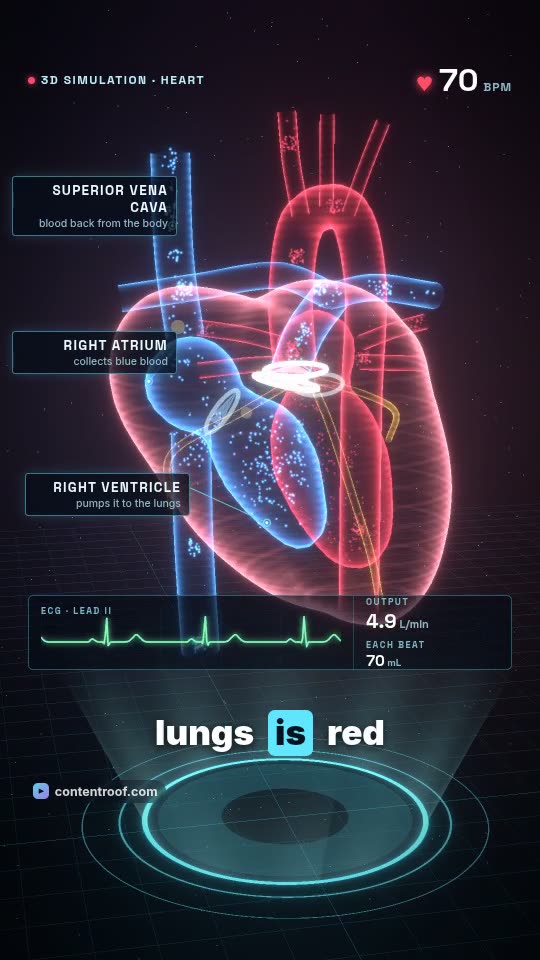 How the heart pumps blood
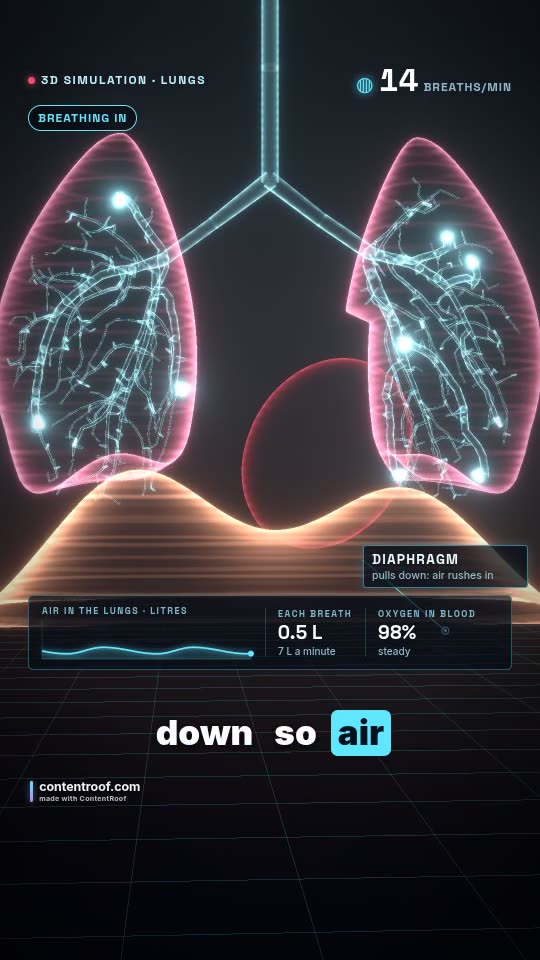 How the lungs work
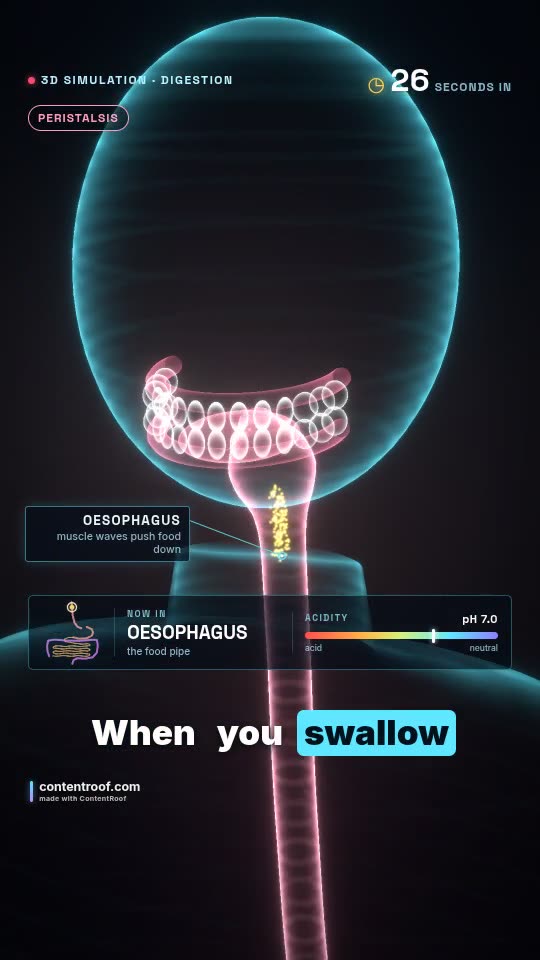 The digestive system
 How a muscle moves a bone
 How the eye works
 How a vaccine trains your immune system
 DNA