3D simulation · Growth and spread
Compound growth, in 3D
Money, bacteria and populations growing on themselves, and why the curve looks flat until it suddenly isn't. Not a drawing and not an AI guess: a simulation that runs the real numbers, narrated, with every moment landing on its word.
What the simulation shows
- The starting amount: one bar.
- Time runs: one bar per period, each a bit taller than the last, the scale following the tallest bar so it curves up like a hockey stick.
- The bars split: the original amount at the bottom (blue), everything it earned on top (gold); a callout: interest on interest.
- The first time the amount doubles lights up, labelled.
- Simple growth without compounding appears beside it in grey, falling far behind.
- A callout: 72 divided by the growth rate gives the years to double.
- Jumps to the last period and counts up the final amount.
The real numbers it runs on
The simulation is built on these facts, so the narration and the picture always agree:
- Compound growth means each period's growth is added to the amount, so the next period grows on a bigger amount: interest on interest.
- The rule of 72: 72 divided by the yearly growth in percent is roughly the years to double (7% → about 10 years; 10% → about 7).
- $1,000 at 7% a year becomes about $7,600 after 30 years; with simple interest (no compounding) only $3,100.
- A single bacterium dividing every 20 minutes would make about 4.7 sextillion in 24 hours if nothing stopped it.
- Rice on a chessboard: one grain on the first square, doubling on each square, ends with about 9.2 quintillion grains on the 64th (more than all the rice ever grown).
- Folding a sheet of paper (0.1 mm) in half 42 times would make it thick enough to reach the Moon, about 440,000 km.
- Inflation compounds the other way: at 3% a year prices double in about 24 years.
The script this video was made from
“The eighth wonder of the world”: the narration of the video above. Each highlighted moment in the simulation happens on the word that names it.
Put 1,000 dollars away and don't touch it. In thirty years it's worth seven times as much. Here's why.
Year by year
Each year it grows seven percent. Not just on the thousand, but on everything it has already earned.
Doubling
After about ten years it has doubled. That's the rule of 72: divide 72 by the rate.
The difference
Without compounding, you'd have just 3,100 dollars.
Patience
With it, 7,600. The secret ingredient is time.
Make your own
- Type a question, like “The eighth wonder of the world”, or your own angle on it.
- ContentRoof picks this simulation, researches the facts and writes a short script, with every moment cued to a word.
- A natural voice reads it in your language and the simulation plays in time with it. Change any line and it follows.
- Download a vertical video for Shorts, TikTok and Reels, or use it in class.
Questions
Is this a real simulation or an AI-generated video?
A real simulation. Compound growth runs on the numbers listed above, so what you see is what actually happens, frame by frame. AI video generators guess what a scene should look like; they often get the science wrong.
Can I change what the narrator says?
Yes. Type your own question or idea and the AI writes a new script for this simulation, or edit any line yourself. Every moment of the simulation lands on the word that names it.
Which languages can it narrate in?
Eleven: English, Urdu, Hindi, Arabic, Spanish, French, Portuguese, German, Italian, Russian and Polish, with captions written properly (Urdu in Nastaliq, Arabic right to left).
Can I use it in class or post it on YouTube?
Yes. The video is yours to use in lessons, on YouTube Shorts, TikTok and Instagram Reels. The free plan makes 2 3D simulations a month; paid plans make more, in 1080p without the small mark.
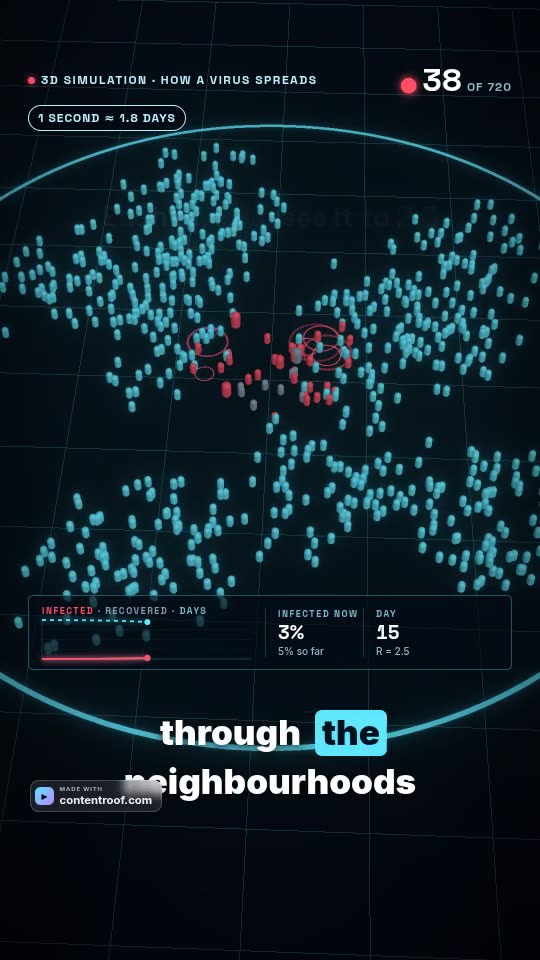 How things spread
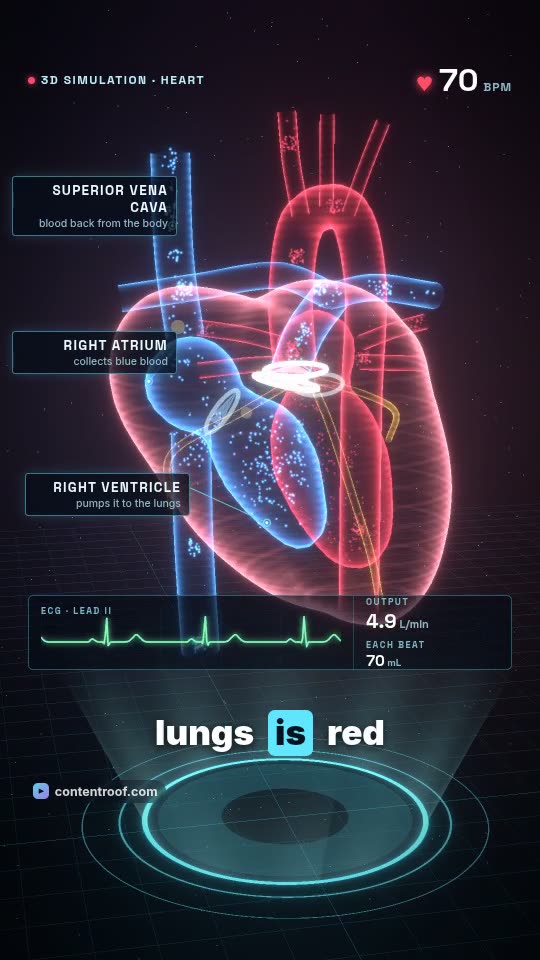 How the heart pumps blood
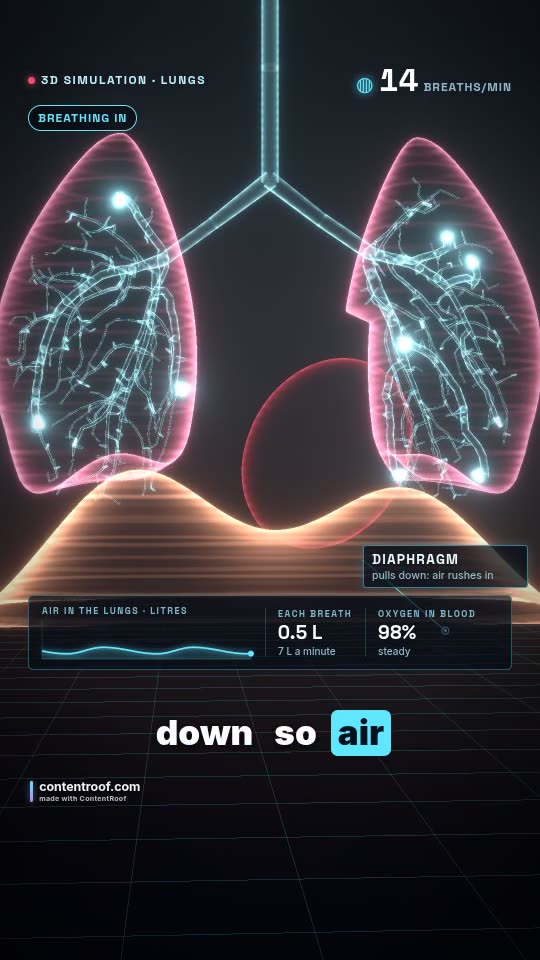 How the lungs work
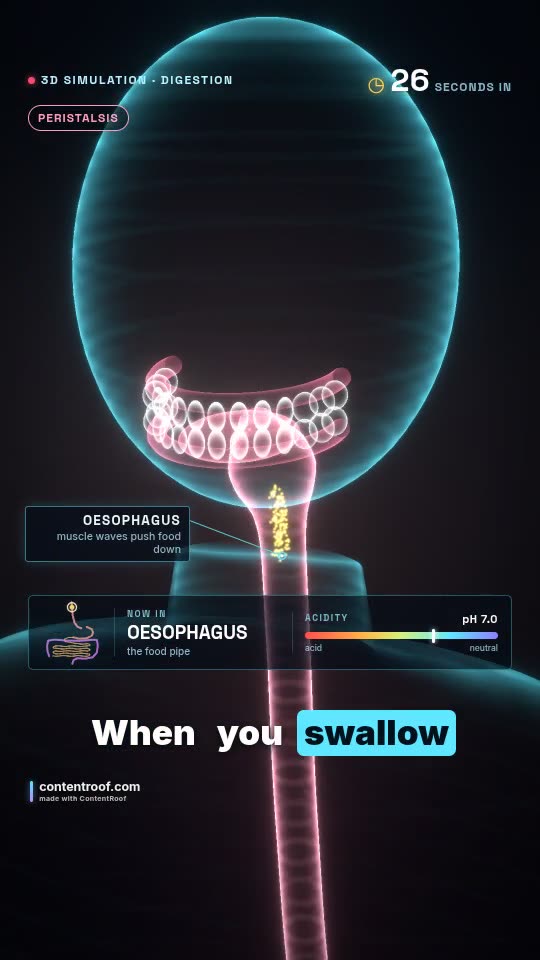 The digestive system
 How a muscle moves a bone
 How the eye works
 How a vaccine trains your immune system
 DNA