

Dubbing keeps the pixels
Automatic dubbing is now free on YouTube, and tools can clone a voice into dozens of languages. What none of them can change is the picture. A chart labelled in English stays in English; "3.5 million" stays "3.5 million" while the voice says something else.1
A ContentRoof video is not pixels. Every label, number, chart, map and caption is generated, so the same explanation can be rebuilt natively: its words in the language, numbers in the language's format (110,25 in Spanish, ١١٠٫٢٥ in Arabic), right-to-left layout for Arabic and Urdu, and the language's own voice.
Figure 1One explanation, five languages
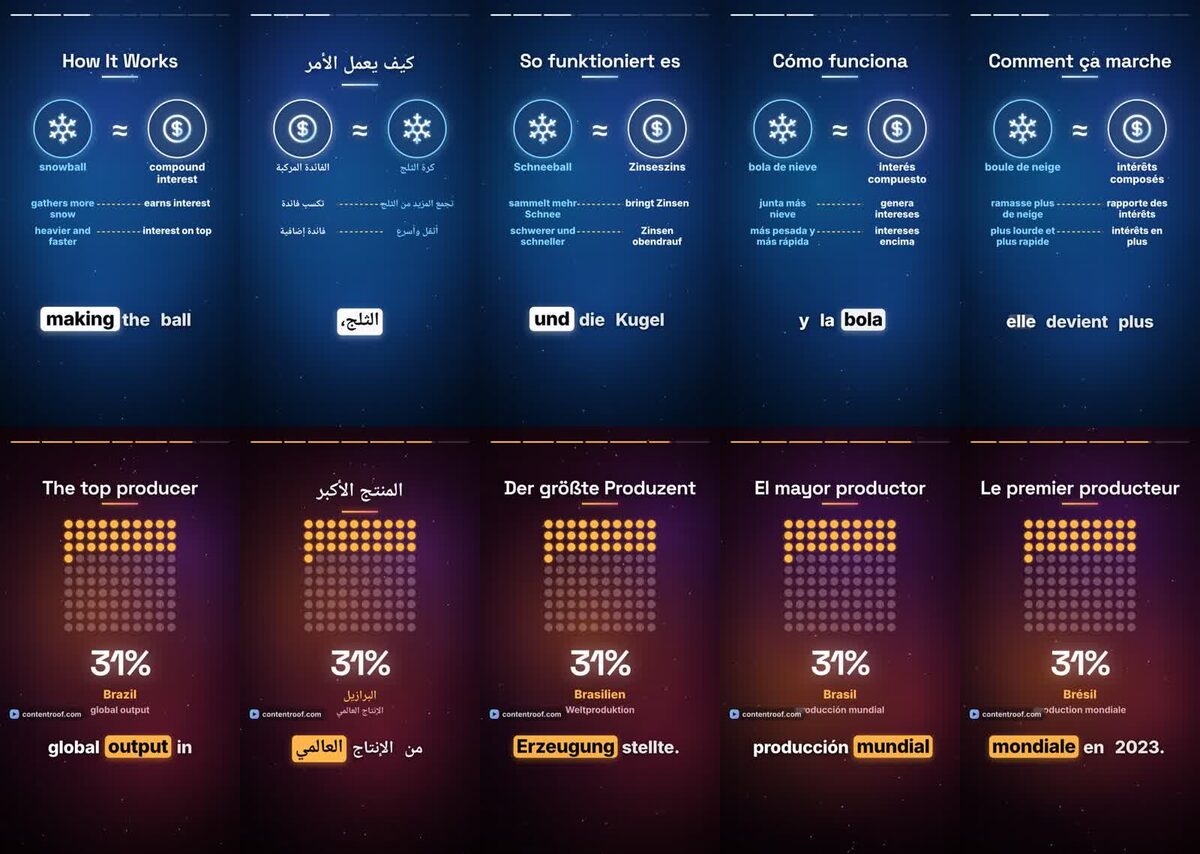 A English, Arabic, German, Spanish, French
Where translation fails quietly
Numbers. Most languages have a word that looks like "billion" and means something a thousand times bigger.
Figure 2The same word, a thousand times apart
A translation that writes 86 billones de neuronas has told a Spanish viewer the brain has 86 million million neurons. It reads perfectly. Nobody listening will notice, and a published study found error rates up to 20% on exactly these words.2 A video that is wrong by a factor of a thousand is worse than no video.
The same goes for decimal points. In German the point separates thousands, so "110.25" reads as 11,025; the German way to write 110.25 is "110,25". A translation that copies the English digits has changed the number.
A checker that reads numbers in every language
So every number in every translation is read in its own language and compared with the original. The reader understands each language's digits and separators, Arabic-Indic and Devanagari digits, scale words including the long-scale false friends, compound forms like mil millones, "half a million", small numbers written as words (tres, drei, ثلاثة), and Arabic duals. When a number is missing or changed, the scene is flagged, and an animated explanation never shows a number its narration doesn't say.
| Planted error | Language | The checker said |
|---|---|---|
| 86 billones for 86 billion | Spanish | missing 86 billion, found 86 billones |
| 86 Billionen | German | missing 86 billion, found 86 Billionen |
| 86 billions | French | missing 86 billion, found 86 billions |
| 86 bilioni | Italian | missing 86 billion, found 86 bilioni |
| 86 مليون (million) for billion | Arabic | missing 86 billion, found 86 million |
| 110,52 for 110.25 | Spanish | missing 110.25, found 110.52 |
| 110.25 left as written | German | missing 110.25, found 11,025 |
| Pakistan's 240 million left out | Portuguese | missing 240 million |
Figure 3What the checker was given and what it said
Data
| Result | |
|---|---|
| Planted errors caught (8) | 8 of 8 |
| Correct controls left clean (2) | 2 of 2 |
| Real translations flagged (23) | 0 of 23 |
| Explained scenes carried (20) | 20 of 20 |
It caught all eight and left both correct controls clean, one of them written entirely in Arabic-Indic digits. On 23 real translations of about 250 scenes it raised no alarm. Getting there meant fixing the checker, not the translations: the first version compared the voice's spelled-out form instead of the screen's digits, read English "86 billion" twice, and counted "ninth century" against "9. Jahrhundert".
Carrying the explanation across
The check is what lets an animated explanation travel. Five explained scenes from four English videos were carried into Spanish, German, French and Arabic: the same animation, translated labels, its steps re-timed to the new voice, and every number checked again against the translated narration. 20 of 20 came through. The first run dropped 8 of them, correctly: the translations spelled "3" as tres and ثلاثة, and the checker refused to show a number it couldn't find in the narration. Teaching it number words fixed that.